
Before you sign a shop, office, warehouse or restaurant lease, scrutinise the premises licence as closely as the rent. In Malaysia, checking a premises licence before leasing can affect your opening date.
Many founders assume that incorporating a company is permission to trade from any unit they can rent. It is not. A company registration and the approvals attached to a physical premises are separate matters, governed by different bodies.
When the paperwork behind a unit does not match the intended activity, fit-out money, deposits and opening dates are exposed. Problems may emerge only after the tenancy is signed, when renegotiation is hardest.
We explain what a premises licence is. We also cover DBKL and MBPJ requirements, food and warehouse premises, landlord documents, and approval sequencing. This helps prevent a lease from locking you in before the checks are complete. In this blog, we discuss the licence checks every founder should complete before committing to premises in Malaysia.
Table of Contents
What is a premises licence, and is SSM registration enough?
No. Registering a company with the Companies Commission of Malaysia (SSM) creates a legal person. A premises licence is the local authority's permission for a specific activity at a specific unit. The two answer different questions.
Foreign founders can also read our guide to setting up a company in Malaysia as a foreigner.
The Kuala Lumpur City Hall (DBKL) premises licence regime illustrates this distinction. DBKL issues premises licences for trade, business and industrial activity at premises, subject to its published exemptions. Its application asks for company or business-registration documents and premises evidence. For a company applicant, incorporation is a precondition, not a substitute. If incorporation itself is still ahead of you, it helps to know what actually delays Malaysian Sdn Bhd incorporation timelines before you sequence lease and licence applications.
Two SSM rules matter here. Under the Companies Act 2016, a company must appoint its first company secretary within 30 days of incorporation. It must also maintain a registered office in Malaysia. Neither requirement identifies the trading premises. Your registered office can be your secretary's address. The leased unit remains a separate commercial decision.
Licence categories and supporting documents depend on the relevant local authority and activity. There is no single national premises-licence process. The exact council for the unit drives the checklist.
Which licences should be on your pre-lease checklist in Malaysia?
The core approvals to confirm before signing fall into five groups.
The exact mix depends on the activity and the council. Selecting the appropriate MSIC code helps describe that activity consistently. Almost every pre-lease review in Malaysia covers the following categories. Treat them as the baseline, then add activity-specific items later in this article.
We describe these as the pattern our team looks at first when a client brings us a shortlisted unit. They are professional judgement, not a legal rule. Check each council's governing documents directly.
1. Local council premises or business licence
This is the council's permission to operate the stated business at the stated unit. The application typically needs company documents, tenancy evidence and premises particulars, and it is usually the licence that conditions your right to open.
2. Signboard or advertisement approval
Signage is separately licensed. Councils regulate the artwork, dimensions, placement and language treatment of signs, and some require the application to run together with the premises licence rather than as a standalone item.
3. Planning and change-of-use approval
A unit approved as an office cannot automatically operate as a café or retail shop. Where the proposed use differs from the approved plan, a change-of-use or planning application to the council's planning side comes first, before fit-out works.
4. Fire safety evidence
Under the Fire Services Act 1988, designated premises generally require a Fire Certificate, except premises used solely or mainly for public religious worship and houses occupied as single private dwellings. Not every leased unit is designated, so confirm whether the building or unit falls within the designated categories and who bears responsibility, rather than assuming every tenant must obtain one.
5. Sector and activity approvals
Some activities need ministry or agency involvement beyond the council. Food premises involve the Ministry of Health; machinery and waste issues may involve the Department of Occupational Safety and Health (DOSH) or the Department of Environment (DOE). We map the actual activity to the responsible body rather than assuming the council licence covers everything.
What does DBKL require for a business premises licence?
For premises inside DBKL's area, two checks come before anything else. First, confirm the unit actually falls under DBKL rather than a neighbouring council. Second, confirm the location and approved use suit the proposed business.
DBKL's published premises-licence criteria state that applicants should not be in a residential zone, and change-of-use applications are referred to its planning department. This is specific to DBKL: other local authorities set their own zoning rules, so a finding for Kuala Lumpur does not settle the position in another city.
DBKL also treats premise-signage advertising as a licensed category. Its published requirements for premise-signage applications include a current premises licence, a visual, location material and other supporting documents. Do not generalise this sequencing to every council or circumstance; use DBKL's current category-specific requirements for the sign you actually intend to put up.
Where the classification of your activity is uncertain, our practice is to seek written confirmation from the council rather than rely on a verbal answer from an agent.
Premises licence documents: DBKL versus MBPJ
| Check | DBKL (Kuala Lumpur) | MBPJ (Petaling Jaya) |
|---|---|---|
| Premises licence | Separate licence for trade, business and industrial activity at the premises | Composite premises-and-signboard application for new applicants |
| Zone and use | Applicants should not be in a residential zone; change of use goes to the planning department | Unit's approved use checked against the proposed activity |
| Company evidence | SSM company or business-registration documents form part of the application | SSM documents listed in the published composite-licence guide |
| Tenancy evidence | Premises particulars supplied with the application | Key pages of a stamped tenancy or sale-and-purchase agreement |
| Signboard | Premise-signage category requires a current premises licence, a visual and location material | Signboard must be applied for together with the premises licence, not standalone |
What does MBPJ require for premises and signboard licences?
In Petaling Jaya, the licensing authority is the Petaling Jaya City Council (MBPJ). Its published guide for new applicants for a composite premises-and-signboard licence lists the documents an applicant must prepare, and the list is instructive for what councils generally want to see.
MBPJ's published documents include SSM company documents, key pages of a stamped tenancy agreement or sale-and-purchase agreement, a floor-plan sketch and photographs of the premises. These are MBPJ's published requirements, not a universal Malaysian checklist, and the guide should be rechecked immediately before any application.
One MBPJ rule worth flagging early: premises-signboard applications must be made together with the premises-licence application, not as a standalone new signboard application. This is specific to MBPJ. DBKL's process and other councils' sequencing may differ, so confirm the rule for your own council before planning the signage budget.
What extra requirements apply to restaurant premises in Malaysia?
Food businesses carry the heaviest licence stack, and most of it should be scoped before the lease, not after the kitchen is built.
Food premises covered by the Food Hygiene Regulations 2009 must be registered with the Ministry of Health. The registration obligation covers food outlets such as restaurants, stalls and canteens, is made through the Food Safety and Information System of Malaysia (FoSIM), and is valid for three years. This registration is separate from the local-authority premises licence; holding one does not satisfy the other, and not every food-related warehouse falls into the same category.
For MBPJ food-premises applications specifically, the published composite-licence document list includes food-handler training certificates, valid anti-typhoid vaccination cards, pest-control documents and, where applicable, exhaust and grease-trap evidence. Limit that list to MBPJ and the applicable food category, and verify the current health conditions for your particular activity with the council.
Beyond these, a café or restaurant usually needs to settle the kitchen exhaust route, grease-trap and waste arrangements, renovation approval, and any liquor or entertainment approval, before fit-out begins. The exhaust route in particular is a common sticking point in end-lot and strata units, because it can cross common property and need building-management consent.
Licence checklist by business activity
| Activity | Core approvals to confirm | Extra items to watch |
|---|---|---|
| Retail shop | Premises licence, signboard approval, planning use for retail | Product mix such as tobacco or liquor may need its own approval; foreign-owned distributive-trade rules may apply |
| Café or restaurant | Premises licence, signboard, MOH registration via FoSIM, renovation approval | Food-handler training, anti-typhoid cards, grease trap, exhaust route and pest control |
| Office consultancy | Premises licence, signboard approval, renovation approval for partitions | Check whether a sector licence applies; external signs on common property need management consent |
| Warehouse or e-commerce | Council premises licence, fire evidence, loading and access conditions | DOSH, DOE, Customs or scheduled-waste involvement depends on the actual stock and equipment |
What are the warehouse licence requirements to check in Malaysia?
There is no single "warehouse licence". What matters is what actually happens inside the unit: the equipment, the stock, and the waste streams. The label on the lease matters less than the operations.
Two regulators come up most often. DOSH publishes workplace, factory and machinery registration categories, so a warehouse with registrable machinery may trigger DOSH involvement. On the environment side, DOE's position is that scheduled-waste handling is governed by environmental legislation and its reporting arrangements.
Use conditional wording here: a plain storage warehouse with no registrable machinery and no scheduled waste may need nothing beyond the council licence and fire evidence. A warehouse with racking, a mezzanine, pressure equipment, controlled goods or scheduled waste is a different matter. A competent adviser must map the actual stock, processes, equipment and waste to the applicable rules.
For e-commerce operators, foreign-owned distributive-trade considerations may also arise depending on the ownership structure and activity. Our guide on when Malaysia requires KPDN approval for foreign-owned e-commerce covers that separately.
What should you request from the landlord before signing?
Our working list of landlord-side documents includes:
This list is a checklist recommendation from our practice, not a mandatory list for every council or unit. MBPJ's guide confirms that tenancy, plan and premises evidence can form part of an application record. Obtain relevant documents before signing the lease.
- Title particulars or a land search where justified
- Quit rent and assessment payment evidence
- The Certificate of Completion and Compliance (CCC), or a Certificate of Fitness for Occupation (CFO) for an older building
- Approved building and floor plans showing the unit's authorised use
- Evidence of the landlord's identity and authority to lease
- Strata management-body (JMB or MC) or building-management consent, where the building is stratified
- Existing fire-system records and any Fire Certificate, if the premises are designated
- Written consent for licensing, renovation, signage, exhaust works and inspections
Previous licences held by an earlier occupier are useful as background only. They do not prove that a new application will be approved. A former occupier's licence does not show that your activity, layout or sign will be approved. Check the licence type and the council's current rules. Councils require current, activity-specific documentation from the actual applicant.
Pre-lease approval sequence and watch-outs
| Step | What happens | Common watch-out |
|---|---|---|
| 1. Define the activity | List goods, services, machinery, storage and sign wording | Vague activity descriptions invite wrong licence categories |
| 2. Check the unit with the council | Confirm zoning, approved use and licence category in writing | Relying on an agent's verbal answer |
| 3. Secure conditional terms | Offer or tenancy made conditional where a core approval is uncertain | Unconditional leases lock the tenant in before checks |
| 4. Incorporate and document | SSM incorporation, company secretary within 30 days, tenancy in the company's name | Tenancy signed before incorporation may need nomination or assignment |
| 5. Obtain pre-work approvals | Renovation, planning, exhaust and change-of-use consents first | Starting fit-out before approvals arrive |
| 6. Finish works and evidence | Inspections, health and fire evidence completed | Unauthorised alterations by a previous occupier surfacing late |
| 7. Final approvals | Premises licence, signboard and sector approvals before opening | Opening before the premises licence is issued |
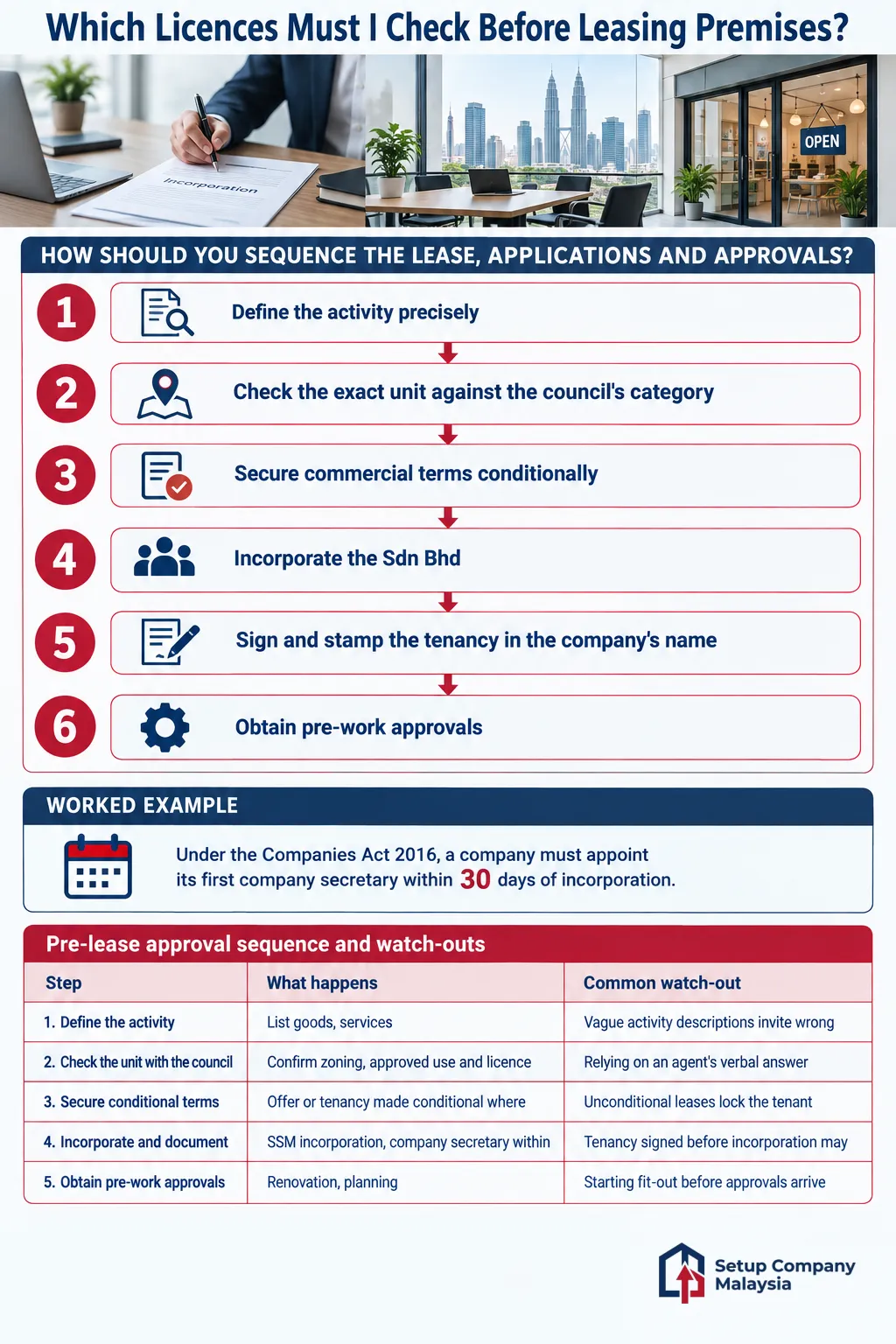
How should you sequence the lease, applications and approvals?
Our suggested sequence, drawn from how we advise clients, is a general risk-management framework rather than a legal rule. Council, activity, tenancy and building facts can change the order.
- Define the activity precisely: goods, services, cooking, machinery, chemicals, storage and sign wording.
- Check the exact unit against the council's category, zoning and approved use, in writing where possible.
- Secure commercial terms conditionally, where a core approval is uncertain.
- Incorporate the Sdn Bhd, so the licence applicant and the tenant are the same legal person. SSM incorporation does not require the trading premises to be secured first.
- Sign and stamp the tenancy in the company's name, with landlord consent to licensing and works.
- Obtain pre-work approvals: renovation, planning, façade, exhaust and change-of-use consents before fit-out begins.
- Complete compliant works, then handle inspections, health requirements and fire evidence.
- Obtain the premises licence, signboard approval and any final sector approvals before opening.
A conditional letter of offer or tenancy can reduce commercial risk where the viability of the activity at the exact unit is uncertain. The drafting, enforceability, nomination, assignment, termination and deposit consequences of such terms require review by a Malaysian advocate and solicitor; we do not offer model clauses.
A common error is treating incorporation, or the previous tenant's licence, as proof that the site is licensable. The next most common is starting exhaust, partition, mezzanine or façade work before planning, building-management and council approval is in place.
What tax registrations follow once the lease is signed?
The lease does not itself determine your tax position. However, a few registrations should be planned alongside the licence work.
For companies incorporated online through SSM's MyCoID portal, LHDN states that company Tax Identification Number (TIN) registration is automatic. A newly operating company with a first basis period of at least six months must submit e-CP204. It must do so within three months of commencement. Keep the six-month qualification in mind. Confirm the filing position and commencement date with a tax professional for your company.
Sales and Service Tax (SST) registration is separate again. Royal Malaysian Customs states that taxable-service providers must register when the prescribed threshold is exceeded. Thresholds vary by taxable service. Leasing premises does not trigger registration. Registration depends on carrying on the relevant taxable business above its threshold. Check the applicable service category, exemptions and threshold with Customs or a tax adviser. Do not assume one number applies to every business.
Conclusion
The licence picture around a leased unit is decided by three variables: the activity, the council, and the paperwork behind the premises. Company registration creates a legal person. Premises approvals determine whether that person can trade from the address.
We help clients scope these checks before commercial terms are signed. We also request landlord documents and sequence incorporation, tenancy and applications. This helps identify avoidable delays early.
If you are weighing a unit right now, read our guide to setting up a company in Malaysia as a foreigner. You can also browse our latest blog posts or reach out through our contact page.
Not sure which licences your premises need?
Tell us the activity, the council and the unit, and we will help you map the approvals before you sign.
Frequently Asked Questions
No. SSM registration creates the company, but the local authority separately licenses the activity at the specific premises. DBKL, for example, requires its own premises licence and asks for company documents within that application.
Not automatically. Under the Fire Services Act 1988, a Fire Certificate is required for designated premises. Confirm whether the building or unit falls within the designated categories and who is responsible, rather than assuming every tenant needs one.
No. Councils require current, activity-specific documentation from the actual applicant. A former occupier's licence is background information only, and it says nothing about whether your activity, layout or sign will be approved.
It depends on the council. MBPJ requires premises-signboard applications to be made together with the premises licence application, not standalone. DBKL treats premise signage as its own licensed category with its own requirements, including a current premises licence.
The lease itself does not trigger registration. Royal Malaysian Customs states that providers of taxable services must register once the prescribed threshold is exceeded, and thresholds vary by service category. Check your applicable category and threshold with Customs or a tax adviser.

Setup Company Malaysia
Author
Setup Company Malaysia explains how to start and register a business in Malaysia and helps founders and foreign investors with company incorporation and business advisory.