Why might a bank ask about your overseas parent when your new Sdn Bhd has no trading history? Once registration is done, life after incorporation for a new Sdn Bhd includes ongoing duties like corporate tax filing and EPF contributions. A foreign-owned company applying for a Malaysian bank account can prepare for questions about its ownership, funding and intended activity before the bank follows up.
Bank Negara Malaysia (BNM) explains that customer due diligence includes identifying the customer and beneficial owner and understanding the purpose of the transaction. These are duties of the reporting institution, not a universal applicant document checklist.
Our team's proposed approach is to explain the business and money flow consistently, without presenting forecasts as sales. This judgement needs practitioner confirmation; a bank may request further evidence or decline, and preparation does not guarantee approval.
This guide discusses how a new Sdn Bhd with an overseas parent can prepare for possible bank questions on ownership, funding and expected activity. The practical recommendations are proposed professional judgements that need practitioner confirmation, not a record of an actual application.
Table of Contents
What Do Malaysian Banks Check Beyond the SSM Record?
A company setup in Malaysia starts with an incorporation record. That record does not by itself explain the parent's ability to fund it or the proposed account activity. In practice, we prepare those explanations alongside the corporate records. The bank may still ask for more, so this is not a guarantee.
According to Bank Negara Malaysia's customer due diligence guidance, a reporting institution identifies the customer and beneficial owner. It also understands the purpose of the transaction. This describes the institution's due diligence, not a universal checklist of documents for every applicant.
SSM's beneficial ownership reporting guidelines describe a beneficial owner as a natural person who ultimately owns or controls a company. Control can extend beyond shareholdings. SSM company-reporting obligations and a bank's due-diligence requests are related but distinct. Apply the relevant identification criteria to the actual structure.
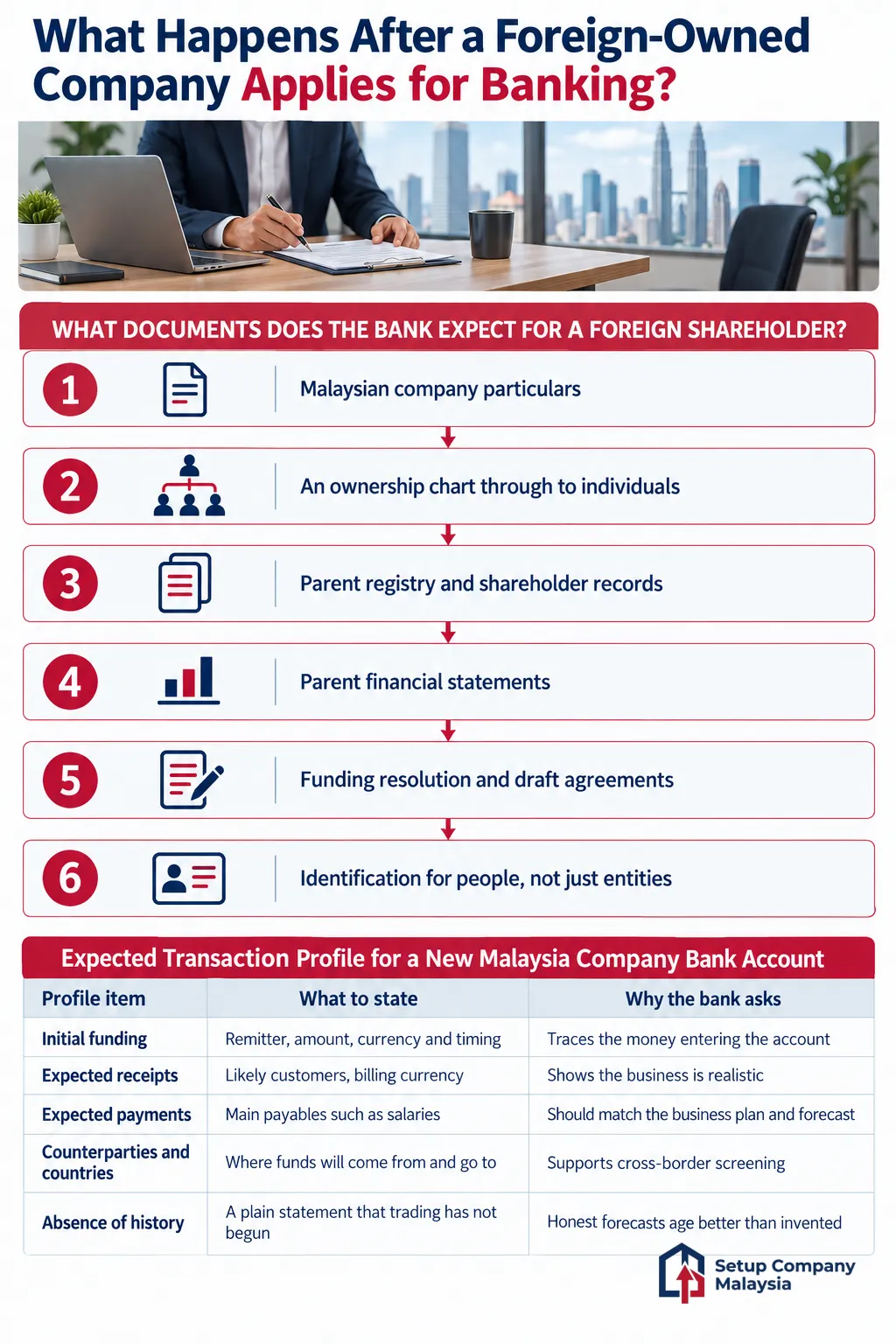
What Documents Does the Bank Expect for a Foreign Shareholder?
Expect to build a pack that connects your Malaysian company to its corporate shareholder. It should end at the natural persons who ultimately own or control the business. That single thread answers most ownership questions before they are asked. This preparation is our professional judgement, not a guarantee; the bank may still request additional evidence.
Start with the Malaysian file: the registration notice from the Companies Commission of Malaysia (SSM). Add the current company profile, registered office details and director particulars. SSM issues a registration notice on incorporation. A formal certificate is issued only on application with the prescribed fee. If you are still choosing a company incorporation service in Malaysia, that step comes before the bank pack. Our guide to setting up a company in Malaysia as a foreigner covers the SSM steps first. Incorporation timelines can still shift if SSM asks for missing particulars, so build the bank pack only after those steps are complete.
From there, the parent records and owner identification complete the picture. The sub-headings below set out what we prepare and why each document earns its place.
1. Malaysian company particulars
The registration notice under the Companies Act 2016, the company profile, registered office details and director particulars. Ask your bank whether it wants the notice or the formal certificate, since the certificate needs a separate application and fee.
2. An ownership chart through to individuals
A dated chart can show the Malaysian applicant and the overseas corporate shareholder. It should end at the individuals who ultimately own or control the business. Include relevant entity and ownership details, and consider control beyond shareholdings. Confirm the approach with your company secretary and ask the bank what further evidence it needs.
3. Parent registry and shareholder records
A current parent registry profile and supporting shareholder records can help explain the corporate shareholder's identity and ownership. Consider its constitution and other authority records where relevant, subject to practitioner confirmation and the bank's requests.
4. Parent financial statements
Relevant parent financial records can help explain its capacity to fund the subsidiary. Confirm the proposed choice with the practitioner and bank; audited accounts are not a universal requirement.
5. Funding resolution and draft agreements
Where relevant, consider a parent resolution and an intercompany agreement explaining the proposed funding. Label drafts by their actual status and confirm the documents with the practitioner and bank.
6. Identification for people, not just entities
Ask the bank what identification it requires for directors, authorised signatories and beneficial owners. Check that names agree with the ownership evidence.
Sdn Bhd Bank Account Documents for a Foreign Shareholder
| Document | What it answers | Practical notes |
|---|---|---|
| SSM registration notice and company profile | That the company exists and its registered details | A formal certificate needs a separate application and prescribed fee |
| Director particulars and identification | Who runs and signs for the company | A private company needs at least one director ordinarily resident in Malaysia |
| Ownership chart to individual owners | Who ultimately owns or controls the applicant | Show every layer, jurisdiction, registration number and ownership interest |
| Parent registry profile and shareholder records | The corporate shareholder's identity and authority | Use current extracts so dates stay visible |
| Parent financial statements | Whether the parent can fund the subsidiary | Recommended from our judgement; confirm with your chosen bank |
| Board resolution and draft loan agreement | The intended route of the first funds | Label drafts clearly by their status |
| Identification for beneficial owners | That the people in the chart are real | Banks match names across the whole pack |
How Do You Answer Source-of-Funds Questions?
We approach source-of-funds questions in two parts. The first is the immediate route into the subsidiary. The second is how the parent generated the underlying funds. Confirm the explanation and supporting evidence with your company secretary and the chosen bank. A loan agreement alone should not be presented as proof of the parent's underlying source of funds.
For illustration only, imagine an untraded Malaysian subsidiary expecting a loan from its overseas parent. A proposed agreement may explain the route. Relevant parent financial records and an explanation of how the parent generated the money may help address the underlying source. The bank decides what evidence it needs.
This is a constructed example, not a client file or actual bank correspondence. No actual application outcome or timeline is established.
1. Document the immediate funding route
Consider stating who will remit the funds, the account and currency involved, and the proposed agreement and timing. Check that the explanation agrees with the available funding documents and forecast.
2. Evidence the underlying source
Explain how the parent generated the money and ask the bank what evidence it needs. Parent bank statements and financial records may help, depending on the circumstances.
3. Keep both answers consistent
Check names, amounts and descriptions across the funding documents, financial records and business plan. Reconciling them is a proposed practical judgement, not a documented finding.
How Do You Present a New Sdn Bhd with No Trading History to the Bank?
When a foreign-owned company applies for a Malaysia bank account with no trading history, the first answer is simple. State plainly that the company has not traded. Then explain the intended business and expected account activity. In practice, we support that explanation with genuine preparation documents and keep forecasts separate from historical sales. This does not guarantee approval.
A business plan can explain why the account is needed. An expected transaction profile can describe anticipated funding, counterparties, countries, currencies, receipts and payments. Label proposals, draft agreements and projections according to their actual status. The profile is prospective, not evidence of completed transactions. The chosen bank may request more information or decline the application.
1. Disclose the absence of sales directly
State that there is no revenue or trading history, if that is accurate, and explain when customers are anticipated within the plan's horizon. Do not present prospective sales as historical transactions.
2. Support the plan with real preparation documents
Consider supporting the plan with genuine proposals, draft customer agreements and staffing or premises arrangements. Label each according to its actual status.
3. Provide an expected transaction profile
Describe anticipated funding, receipts, payments, counterparties, countries and currencies. Treat any amounts as forecasts, not actual transactions, and check them against the business plan.
4. Reconcile the whole pack before submission
Check names, ownership interests, funding amounts and business descriptions across the chart, plan, forecast and interview answers. Our team's proposed judgement is that this may make follow-up responses clearer; it is not a documented finding or a confirmed practitioner practice.
Expected Transaction Profile for a New Malaysia Company Bank Account
| Profile item | What to state | Why the bank asks |
|---|---|---|
| Initial funding | Remitter, amount, currency and timing of the first remittance | Traces the money entering the account |
| Expected receipts | Likely customers, billing currency and a monthly range | Shows the business is realistic, not decorative |
| Expected payments | Main payables such as salaries, rent and supplier invoices | Should match the business plan and forecast |
| Counterparties and countries | Where funds will come from and go to | Supports cross-border screening |
| Absence of history | A plain statement that trading has not begun | Honest forecasts age better than invented sales |
What Should You Ask the Bank After Submission?
Approval, account opening, receipt of funds and working online access are distinct milestones. In practice, we ask the bank what each means for the application. Confirm the terminology with the bank and your company secretary; no actual activation date or elapsed time is established here.
Before arranging travel or certification, ask the chosen bank who must attend and what identification is needed. Also ask which certification it accepts for overseas documents. These arrangements are application- and bank-specific; the draft does not establish requirements for any particular bank.
How Do You Manage Bank Follow-Up Requests Efficiently?
Our team's proposed working method is to use an indexed pack, nominate a respondent and keep a query-and-response log. This may help organise follow-ups, but it needs practitioner confirmation and is not a claim that it reduces delays.
The following steps are preparation ideas rather than a confirmed account of how a client application was handled.
1. Build one indexed pack
Consider indexing ownership evidence, relevant parent financial information, funding evidence and agreements, and the operating and transaction plans. Confirm the document choices with the practitioner and chosen bank.
2. Nominate one respondent
Consider nominating a person to coordinate replies so that answers can be checked for consistency.
3. Keep a query-and-response log
Consider recording each bank question, the response, its date and the documents supplied. Confirm with the practitioner whether this working method is appropriate.
4. Ask about certification and attendance before booking anything
Get the bank's instructions in writing: who must attend, which identification, and which certification it accepts for overseas documents. These arrangements are bank-specific, so never assume.
5. If the bank asks for more, answer rather than restart
Respond to the specific evidence requested and ask for clarification if needed. A further request is not itself a rejection, but the bank may still decline the application.
Conclusion
For an untraded subsidiary, the preparation is to connect ownership to the relevant individuals. Distinguish the funding route from its underlying source, and explain expected activity honestly. Check the details across the pack and respond to the bank's actual questions.
Our team can discuss these preparation steps with you. They are professional guidance, not a guarantee; the bank makes its own decision and may ask for more evidence or decline.
If your Sdn Bhd is preparing a bank application in Malaysia, get in touch. We can discuss the application and possible follow-up questions.
Prepare Your Bank Application With Us
We help foreign-owned Sdn Bhd companies assemble ownership, source-of-funds and transaction documents, and answer the bank's follow-up questions.
Frequently Asked Questions
A lack of trading history does not automatically disqualify an applicant. Our team's proposed approach is to explain ownership, funding and intended activity without presenting forecasts as sales. Confirm it with the practitioner; the bank may request more evidence or decline.
Possible preparation documents include Malaysian company particulars, an ownership chart, parent registry and shareholder records, relevant financial and funding records, and identification. These are proposed choices needing practitioner confirmation, not a universal checklist; ask your bank what it requires.
A loan agreement can explain the proposed route into the subsidiary, but it does not by itself prove how the parent generated the underlying funds. Discuss the evidence with the practitioner and chosen bank.
It depends on the bank and application. Ask the bank in writing who must attend and what identification and certification it accepts before arranging travel or certification.
The time varies by bank and application; no fixed timeline is established here. Approval, account opening, receipt of funds and working online access are distinct milestones, so confirm what each means and when your bank expects to complete them.

Setup Company Malaysia
Author
Setup Company Malaysia explains how to start and register a business in Malaysia and helps founders and foreign investors with company incorporation and business advisory.