
How long your Malaysia Sdn Bhd (a Sendirian Berhad, or Malaysian private limited company) takes to become genuinely ready to trade is a different question from how long SSM takes to register it. If you are still deciding whether a Sdn Bhd is even the right vehicle, our comparison shows how a sole proprietorship, partnership, Sdn Bhd and LLP differ in Malaysia. In our work, the registration step itself is usually the quickest part of a launch; the real waiting happens around it.
A company becomes ready when several workstreams line up:
- SSM registration
- A working bank account
- The licences your activity and premises need
- Tax registration
- Permission for foreign founders to work here
Before you work through those one by one, treat the preparation checklist as your earliest action: settle names, ownership, KYC and premises-licensing checks before the SSM, banking, licensing and immigration workstreams begin.
Treating all of these as one single statutory timeline is a common planning mistake.
The consequences are practical: leases signed before licences are cleared, supplier contracts that assume an account still in onboarding, and launch dates that slip. We help clients plan an Sdn Bhd launch as one coordinated project, and this guide shares that planning framework rather than measured service benchmarks.
In this blog, we discuss what each workstream involves and which delay points practitioners check first. We also cover what you can prepare before and after submission, so you can plan a realistic launch date. For what comes next, our guide to life after incorporation covers registering a new Sdn Bhd’s corporate tax and EPF obligations in detail.
Table of Contents
What Workstreams Make Up a Malaysia Sdn Bhd Incorporation Timeline?
A Malaysia Sdn Bhd launch has five workstreams: SSM incorporation, company banking, licensing, tax registration and, where a foreign founder will work here, work authorisation. Each runs on its own clock, with a different decision-maker and its own delay points.
SSM (the Companies Commission of Malaysia) controls the registration. Your chosen bank controls account onboarding. Your local authority or sector regulator controls licences. HASiL (the Inland Revenue Board of Malaysia) and the Royal Malaysian Customs Department control tax registrations. Immigration authorities control work passes.
These clocks overlap, so never add them together. We use this framing with clients as a planning tool, not as a measured timeline of completed files. The table below summarises who controls each workstream and what can hold it up.
Sdn Bhd Launch Workstreams and Who Controls Each
| Workstream | What it covers | Who controls the clock | What can hold it up |
|---|---|---|---|
| SSM registration | Name reservation, incorporation filing, registration notice | Companies Commission of Malaysia (SSM) | Incomplete documents or name objections |
| Company bank account | KYC review, approval, activation, online banking access | Your chosen bank | Ownership-chain and source-of-funds queries |
| Licences and permits | Premises, food, signboard and sector approvals | Local authority or sector regulator | Premises documents and layout corrections |
| Tax registration | Income-tax file, employer file, SST where applicable | HASiL and Royal Malaysian Customs Department | Activity classification and missing details |
| Founder work authorisation | Employment Pass or an equivalent route for foreign founders | Immigration authorities (ESD) | Employer eligibility and document readiness |
What Does SSM Company Registration Involve and Cost?
The SSM step is usually the fastest part of the launch. Once your name is cleared and your documents are complete, incorporation itself is short; delay at this stage usually comes from preparation, not the registry.
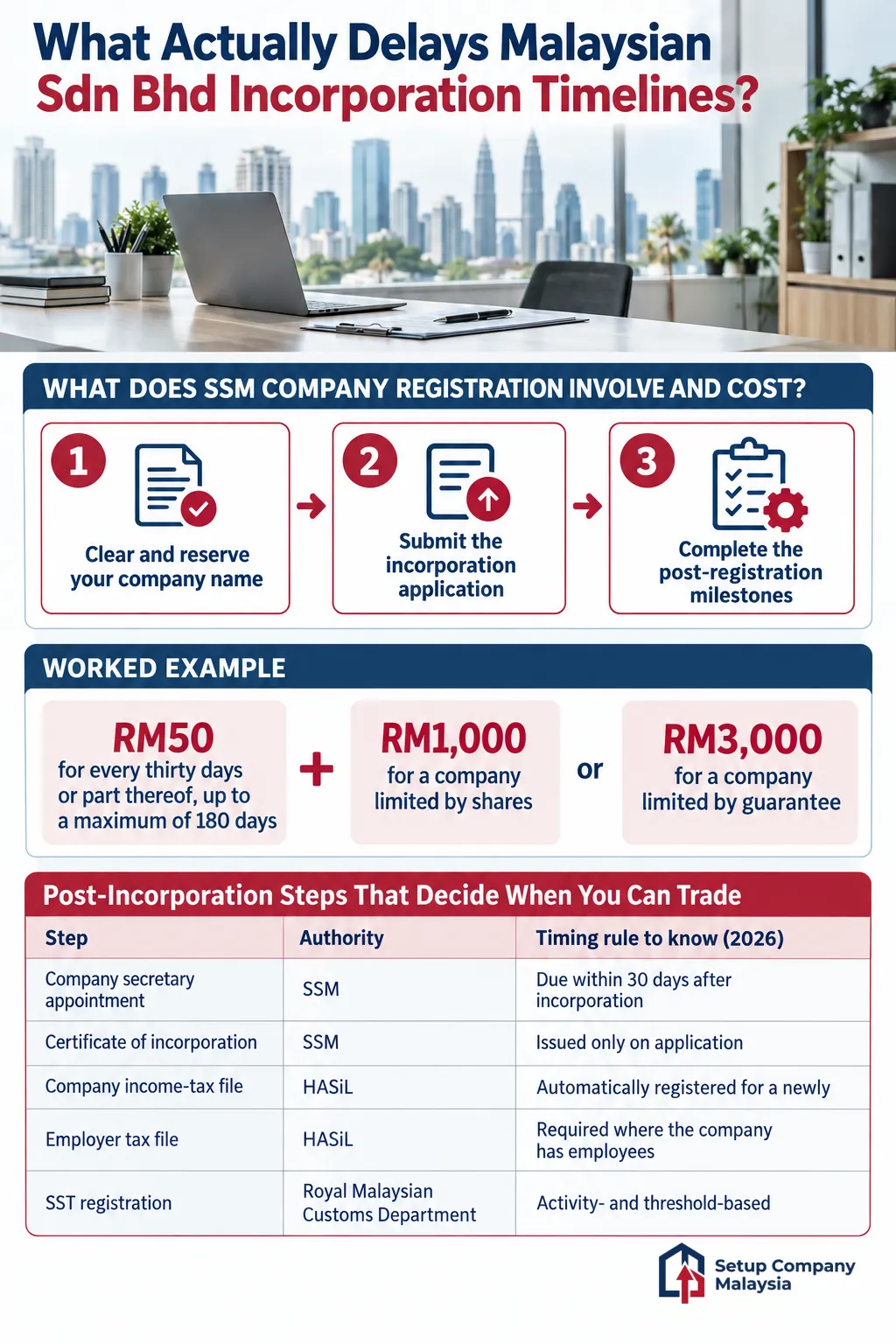
The process starts with a name application. Under SSM's published table of fees, current at October 2026, name reservation costs RM50 for every thirty days or part thereof, up to a maximum of 180 days. Incorporating a company limited by shares costs RM1,000, and a company limited by guarantee costs RM3,000.
Since 14 July 2026, SSM requires corporate filings, statutory lodgements, incorporation applications and notifications through its Corporate Registry System (CRS). The CRS is a unified electronic platform under SSM's practice directive on electronic lodgement.
These milestones frame the plan when you register a company in Malaysia, and the delays usually sit just outside them.
Step 1: Clear and reserve your company name
A name too similar to an existing company, or one SSM finds objectionable, means a resubmission and a fresh cycle. Screen a shortlist of alternatives before you start.
Step 2: Submit the incorporation application
The application sets out the proposed name, private or public status, business type, registered office and addresses, plus full details of directors and promoters. According to SSM's current incorporation guidance, a private company needs at least one director who ordinarily resides in Malaysia, with a principal place of residence here.
Step 3: Complete the post-registration milestones
When SSM is satisfied, it enters the company in the register and issues a notice of registration. A certificate of incorporation is issued only on application and payment of a prescribed fee. A company secretary must be appointed within 30 days after incorporation, and a constitution is optional for a company limited by shares.
What Typically Delays the SSM Submission Itself?
We look first at four things that can delay the SSM submission itself: identity and Know Your Customer (KYC) documents, the company name, the ownership chain and the business description. Premises documents are a separate pre-launch licensing issue, so settling them early can prevent a later delay.
These are ordinary documentation issues, not exotic problems. They are the checks an experienced practitioner runs early on, not a ranking of what most often goes wrong, which we have not measured.
The table below separates SSM submission issues from premises work that should be handled before a licence application.
1. Incomplete KYC and identity documents
Missing or inconsistent identity documents for directors, promoters or beneficial owners can stall a submission. Assemble certified copies and current addresses before you file.
2. Name objections and resubmissions
An objectionable or similar name sends you back to the start of the name stage. Prepare several alternatives in advance.
3. Gaps in the ownership chain
Where an overseas corporate shareholder sits above the company, SSM and banks expect a clear chain to the ultimate beneficial owners. SSM's beneficial-ownership reporting framework makes this a standing obligation, so settle it early.
4. Unclear business activity
A vague activity description invites queries and rework. Choosing the right Malaysia Standard Industrial Classification (MSIC) code for your new company, and describing the activity consistently, helps the file move cleanly.
5. Premises documents not settled
Tenancy documents are not normally an SSM submission requirement. They matter for licensing, and starting late creates a knock-on effect at the licence stage.
Common SSM-Stage Delays and How to Prevent Them
| Delay point | Why it happens | What to prepare in advance |
|---|---|---|
| Founder KYC | Missing or inconsistent identity documents | A complete KYC pack for every director and promoter |
| Company name | Similarity to an existing name or an objectionable element | A shortlist of screened alternative names |
| Ownership chain | Unclear structure above the company or unknown beneficial owners | A settled structure chart and shareholder records |
| Business activity | Vague description or the wrong MSIC code | A consistent activity description tied to the correct MSIC code |
| Premises documents | A pre-launch licensing issue: tenancy or layout papers may be needed when a licence is required | Premises due diligence before signing a lease |
How Long Does Malaysia Company Bank Account Opening Take?
It varies by bank and ownership structure, and it can be the longest wait after registration, particularly for foreign-owned companies. Malaysia company bank account opening time is set by the bank's own onboarding review, not by SSM.
Banks review your incorporation particulars, ownership chain, business model and source of funds. Where an overseas corporate shareholder sits above the company, expect additional document requests. Each bank sets its own checklist, so confirm current requirements with your chosen bank before you schedule anything.
Approval is not the same as being able to transact. After approval, the account still needs activation, initial funding, online banking setup and signatory access before you can pay suppliers. We plan for that gap with clients rather than quoting a single opening day.
If you are setting up a company in Malaysia as a foreigner, start the banking conversation earliest. It is the workstream most exposed to document loops.
What Affects the Malaysia Business Licence Timeline and Tax Registration?
Your activity and premises decide the licence timeline, while tax registration is a separate and usually faster set of steps. Malaysia business licence timelines are set by your local authority and any sector regulator, never by SSM.
For example, Kuala Lumpur City Hall (DBKL) processes business, premises and advertising licences, and its published requirements vary by activity. Other councils have their own forms, approval order and timing, so do not assume one city's rules apply to another. Before you commit to premises, work out which licences to check before leasing premises, because council rules can change what you sign.
Sector approvals sit on top of council licences. KPDN's distributive-trade rules apply to foreign operators in that sector, while MIDA's manufacturing materials cover licence and exemption routes by activity and scale. Scope these against your exact business, not your broad sector label.
On tax, HASiL's e-Daftar system handles company income-tax registration, and a company with employees must also register an employer tax file. Sales and service tax (SST) registration is not automatic. It depends on your taxable activity and the applicable thresholds. Check the current rule for your goods or services with the Royal Malaysian Customs Department. The post-incorporation checklist includes SSM’s separate secretary-appointment deadline and any optional certificate request, along with HASiL and Customs tax registration, local authority licences and, where relevant, Employment Pass approval through the Expatriate Services Division (ESD). The table below separates these requirements.
Post-Incorporation Steps That Decide When You Can Trade
| Step | Authority | Timing rule to know (2026) |
|---|---|---|
| Company secretary appointment | SSM | Due within 30 days after incorporation |
| Certificate of incorporation | SSM | Issued only on application, with the prescribed fee |
| Company income-tax file | HASiL | Automatically registered for a newly incorporated company registered online with SSM through MyCoID; otherwise apply through e-Daftar |
| Employer tax file | HASiL | Required where the company has employees |
| SST registration | Royal Malaysian Customs Department | Activity- and threshold-based, never automatic |
| Premises, food and signboard licences | Local authority (for example, DBKL in Kuala Lumpur) | Requirements and timing vary by council, activity and premises |
| Employment Pass for a foreign founder | ESD and immigration authorities | Approval before issuance; work only for the named company |
How Does Foreign Ownership Affect the Launch Timeline?
Foreign owned company registration in Malaysia usually takes longer than a purely local file because of shareholder documents, bank review and immigration steps. Foreign ownership itself is not the constraint; the paperwork and work authorisation are.
The resident-director rule still applies, so settle the structure before you file. Where an overseas corporate shareholder sits above the company, its records and evidence of authority can create a document-correction loop. Ask SSM and your bank what form they require before documents are prepared overseas.
Founders often miss one point: owning a Malaysian company does not by itself allow a foreign founder to work in it. ESD's official Employment Pass guidance states that the pass enables employment with a named organisation. It requires approval before issuance and permits work only for the company named in the pass. The right route and eligibility must be assessed for the individual role, which is specialist immigration territory.
If you plan to sell online, check when foreign-owned e-commerce needs KPDN approval, because distributive-trade rules can apply to foreign operators in that space.
What Can You Prepare Before Incorporation Is Complete?
Preparation can start well before submission. Treat it as the stage to settle before you reach the SSM, banking, licensing and immigration workstreams described above, but most formal applications still need the company's incorporation particulars, so treat preparing and applying as two different things.
A bank may discuss your proposed company before registration, but that is not account approval. A licence application in the company's name generally needs incorporation particulars plus whatever premises prerequisites the scheme requires. Immigration routes depend on the incorporated employer's own eligibility. Confirm the start point with your selected bank, local authority, sector regulator and immigration adviser.
None of this is a filing. It just means the real applications begin from a complete base, which is usually where the time is won.
What Can You Settle Before Submitting Anything to SSM?
- Screening shortlists of company names
- Settling the ownership and beneficial-ownership structure
- Assembling the KYC pack for every director, promoter and shareholder
- Assessing premises and activity licensing before you sign a lease
- Holding indicative discussions with banks
- Preparing immigration documents for any founder who needs work authorisation.
Conclusion
The pattern to take away is simple: SSM registration is usually the quick part. Banking, licensing, tax registration and work authorisation decide when you can actually trade. Watch KYC completeness, the company name, the ownership chain, your MSIC code, bank onboarding, council requirements and the Employment Pass route.
We help clients with Sdn Bhd incorporation, licence and activity reviews, tax-registration coordination and advisory for foreign investors. A realistic Malaysia Sdn Bhd incorporation timeline is easier to plan when each workstream has an owner and a checklist.
If you are weighing a launch, get in touch and we will map the workstreams for your specific business before you commit to dates.
Map Your Sdn Bhd Launch Timeline
Tell us your business activity, ownership structure and target launch date. We will flag the likely delay points and manage the filings with you.
Frequently Asked Questions
The SSM registration step is usually the fastest part of a launch once your name is cleared and your documents are complete. Readiness to trade also depends on banking, licences and tax registration, so plan the whole timeline, not just the registration.
No. SSM issues a notice of registration when it incorporates the company. A certificate of incorporation is issued only if the company applies for it and pays the prescribed fee.
Not under SSM's rules. Appointing a company secretary is a separate statutory obligation due within 30 days after incorporation. Individual banks may include it in their own checklist, so confirm with your bank.
No. SST registration depends on the company's taxable activity and the applicable thresholds set by the Royal Malaysian Customs Department. Check the current rules for your particular goods or services.
Ownership alone does not authorise work. An Employment Pass is tied to employment with the named company, requires approval before issuance, and permits work only for that company. Eligibility and the right route must be assessed for the individual role.

Setup Company Malaysia
Author
Setup Company Malaysia explains how to start and register a business in Malaysia and helps founders and foreign investors with company incorporation and business advisory.