Foreign-owned e-commerce sellers often ask whether their Sdn Bhd in Malaysia needs KPDN approval before it sells physical goods online. If the company is selling to Malaysian customers, it can fall within Malaysia's distributive trade rules. That can be so even if it never opens a walk-in shop.
Selling through a marketplace or keeping stock with a fulfilment provider does not, by itself, put the company outside the guideline. Running the business from a laptop does not do so either.
Many founders assume that once the Companies Commission of Malaysia (SSM) issues the incorporation notice, the regulatory story is complete. Even the classification you declare at incorporation shapes that story, so it is worth learning how to choose the right msic code for a new business activity in Malaysia. In practice, KPDN administers separate guidelines on foreign participation in distributive trade. Those guidelines expressly reach e-commerce, wholesalers and retailers.
Getting this wrong is rarely dramatic on day one. It can surface later:
- A premises licence stalls
- A bank questions the account opening
- An employment pass application hits a snag
- A buyer's due diligence flags the gap.
Read the GP2022 provisions that bring online selling into scope and the RM1 million shareholders' funds threshold. It also explains marketplace, 3PL, cross-border and B2B structures. Finally, it flags other screens for foreign-owned online sellers. In this blog, we discuss the GP2022 provisions that pull online selling into scope, the RM1 million shareholders' funds requirement, and the practical checks for marketplace, 3PL, cross-border, B2B and other regulatory screens.
Table of Contents
Why Does KPDN's Distributive Trade Guideline Cover Online Selling?
Because the guideline defines distributive trade broadly enough to include retailers, wholesalers and business conducted through electronic transactions. KPDN is the Ministry of Domestic Trade and Cost of Living, the regulator responsible for distributive trade policy in Malaysia.
Its Guidelines on Foreign Participation in Distributive Trade Services, commonly called GP2022, set the framework. One wording distinction matters: GP2022 states that approval must be obtained for applications involving foreign participation in distributive trade, including new outlets, relocation and expansion. Separately, it says foreign operators are encouraged and recommended to obtain approval before operating. We do not collapse those two wordings into a single universal licensing rule; the right step depends on your structure.
Also note that this is the published guideline's scope language, not a published KPDN ruling on a particular merchant, marketplace or fulfilment structure. GP2022 is an administrative approval regime rather than an SSM incorporation prohibition. But proceeding without the required approval can obstruct premises licensing, banking, immigration and later regulatory due diligence, so it sits on top of company incorporation in Malaysia rather than replacing it.
Which GP2022 Provisions Pull E-Commerce Into Scope?
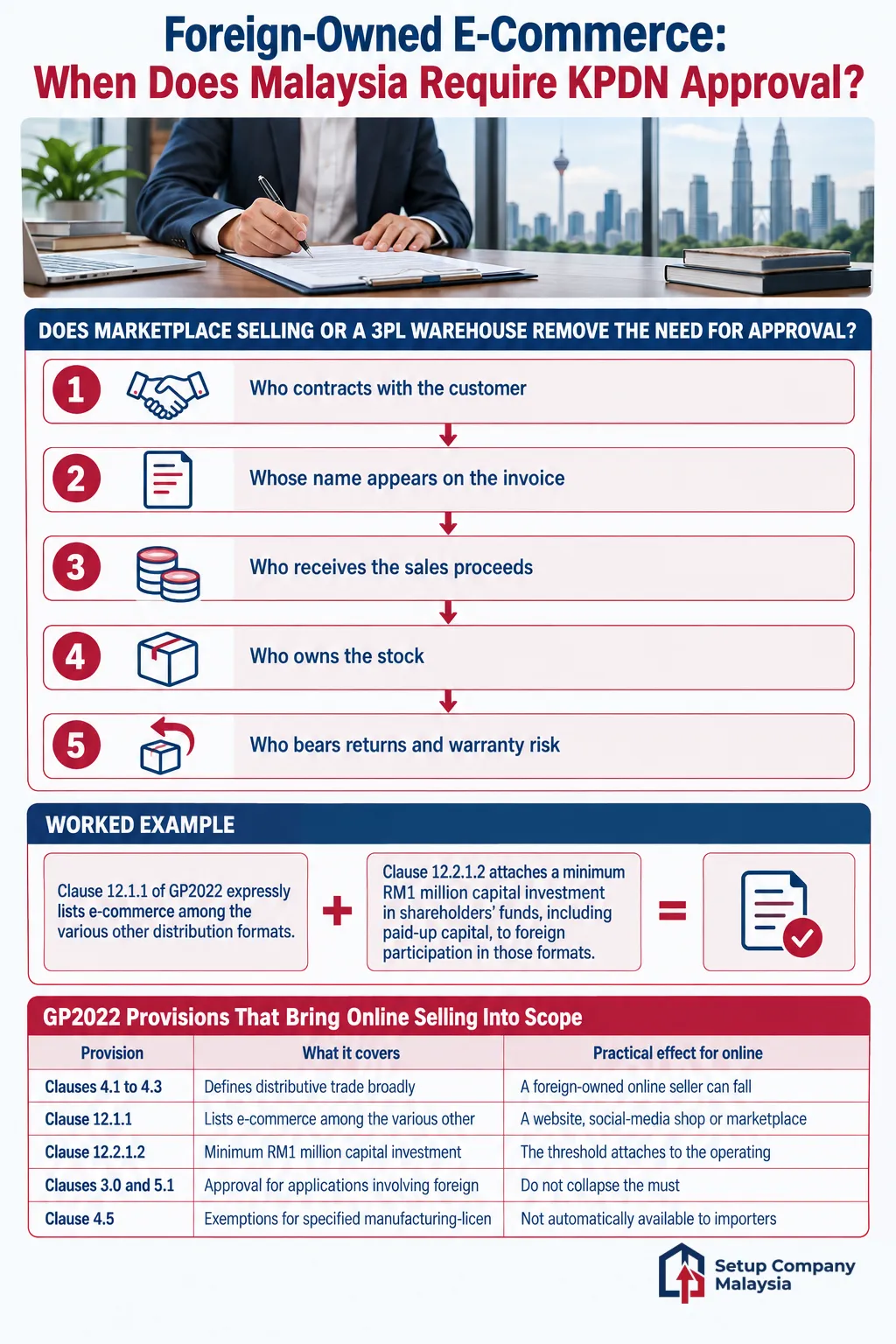
Three groups of provisions matter most for online sellers. Clause 12.1.1 of GP2022 expressly lists e-commerce among the various other distribution formats. Clause 12.2.1.2 attaches a minimum RM1 million capital investment in shareholders' funds, including paid-up capital, to foreign participation in those formats. Clauses 4.1 to 4.3 define distributive trade broadly enough to capture retail and wholesale activity conducted online.
Be careful not to over-read this. The guideline uses qualified, fact-specific language; it is not an express rule that every online sale automatically requires approval. Equally, we can find no published blanket exemption for online-only, marketplace-only, outsourced-fulfilment or 3PL sales models. GP2022's listed exemptions concern companies holding manufacturing licences that distribute only products under the same production line, and specified MIDA regional establishments — not importers, resellers or online merchants generally.
Treat that as an absence of an express published exemption, not as proof that KPDN will require approval in every online-only model. For borderline structures, our approach is to obtain case-specific written confirmation from KPDN before launch.
GP2022 Provisions That Bring Online Selling Into Scope
| Provision | What it covers | Practical effect for online sellers |
|---|---|---|
| Clauses 4.1 to 4.3 | Defines distributive trade broadly, covering retailers, wholesalers and online businesses | A foreign-owned online seller can fall within scope |
| Clause 12.1.1 | Lists e-commerce among the various other distribution formats | A website, social-media shop or marketplace is still distribution |
| Clause 12.2.1.2 | Minimum RM1 million capital investment in shareholders' funds, including paid-up capital, for foreign participation | The threshold attaches to the operating company |
| Clauses 3.0 and 5.1 | Approval for applications involving foreign participation; foreign operators encouraged and recommended to obtain approval before operating | Do not collapse the must and the recommended wording into one rule |
| Clause 4.5 | Exemptions for specified manufacturing-licence holders and MIDA regional establishments | Not automatically available to importers, resellers or online merchants |
What Does the RM1 Million Shareholders' Funds Requirement Actually Mean?
It means RM1 million of accounting equity attributable to the operating company, not simply the amount originally paid for shares. GP2022 clause 12.2.1.2 refers to a minimum capital investment in shareholders' funds, including paid-up capital.
Shareholders' funds includes paid-up capital, but GP2022 does not say that the two always equal each other. We ask the company's accountant to confirm the applicable financial-reporting treatment before relying on any figure.
A new company may meet the threshold by issuing and receiving at least RM1 million of share capital. Start-up costs and early trading losses may reduce net shareholders' funds below the threshold. In practice, we normally advise funding above RM1 million to leave a cushion.
Evidence we prepare to show shareholders' funds includes:
- Bank records showing the share capital actually received
- The register of members and share allotment documents
- Current management accounts or audited accounts
Evidence we prepare to show shareholders' funds includes:
Bank records showing the share capital actually received, the register of members with share allotment documents, and current management accounts or audited accounts evidencing the equity position.
Shareholders' Funds Versus Paid-Up Capital
| Item | Effect on shareholders' funds | Practical note |
|---|---|---|
| Issued and paid-up share capital | Included | The most common way a new company meets the RM1 million level |
| Reserves and retained earnings | Included | Can lift equity above the amount originally paid in |
| Accumulated losses | Deducted | Start-up costs and early trading losses can pull net funds below RM1 million |
Does Marketplace Selling or a 3PL Warehouse Remove the Need for Approval?
A foreign-owned e-commerce business in Malaysia may still need KPDN approval when it sells through a marketplace or uses a 3PL. The outcome remains fact-specific.
GP2022 expressly includes online businesses, and it publishes no blanket exemption for marketplace-only or outsourced-fulfilment models. The guideline also says a distribution centre may serve online-retailer and e-commerce order fulfilment. It does not decide how an independent 3PL is treated for a particular merchant. For that branch, we obtain written KPDN confirmation rather than assume either way.
When we review a foreign-owned online seller, we start from the company's role as the seller of record. This is our firm's analytical approach; it is not a published KPDN legal test or ruling. The factors we look at first are:
1. Who contracts with the customer
If the Malaysian Sdn Bhd is the contracting party at the marketplace checkout, it is acting as the seller to Malaysian customers rather than a bystander.
2. Whose name appears on the invoice
A company that issues the invoice in its own name presents itself as the party making the sale.
3. Who receives the sales proceeds
Where settlement from the marketplace or payment gateway lands in the company's Malaysian bank account, the company is collecting the trade proceeds.
4. Who owns the stock
Ownership of the inventory — whether it sits in the company's own warehouse or with a 3PL — goes to the heart of whether the company is the distributor.
5. Who bears returns and warranty risk
A company that absorbs refunds, exchanges and warranty claims carries the commercial risk of the trade.
How Do Cross-Border, Click-and-Collect and B2B Models Change the Analysis?
Each of these structures changes the facts, and the analysis follows the facts. None of them can be resolved with a rule of thumb.
1. Cross-border seller-of-record models
A foreign seller may remain the genuine seller of record and ship each order from abroad. Its Malaysian company may only provide marketing or support. That model may require a different analysis from one in which a Malaysian company imports, stocks and sells locally. This distinction is fact-sensitive, not a settled exemption. If the model later moves to local stock, local invoicing or collecting proceeds in Malaysia, the position needs a fresh KPDN review.
2. Click-and-collect, showrooms and pop-ups
GP2022 requires approval for applications concerning new branches or outlets, and it defines a branch as an outlet separate from headquarters. Whether a collection point, returns counter, showroom or pop-up is legally an outlet is a confirmation-dependent question — we check it with KPDN and the relevant local authority before committing to the location.
3. B2B and wholesale selling
Selling to businesses rather than consumers does not move the sale outside distributive trade. GP2022 defines wholesale trade as the sale or resale of new and/or used goods and services to distributors that purchase them for the purpose of conducting business. Product-specific regulation, the buyer's role and any applicable exemption must still be checked.
Common Online Selling Models and the KPDN Question
| Model | Typical analysis | What we recommend |
|---|---|---|
| Marketplace-only store, stock at a 3PL | Company can still be the distributive trader if it is the seller of record | Apply for approval or obtain written KPDN confirmation first |
| Foreign parent remains seller of record, ships cross-border | A genuinely services-only Malaysian company may be distinguishable | Document the model; review again before switching to local stock or invoicing |
| Click-and-collect, showroom or pop-up | May add outlet, premises and local-authority questions | Check with KPDN and the local council before committing |
| B2B wholesale to businesses | Wholesale is distributive trade under GP2022 | Seek approval and check product-specific import controls |
Do the 2024 Electronic Trade Regulations Replace KPDN Approval?
No. The Consumer Protection (Electronic Trade Transaction) Regulations 2024 — in force from 25 December 2024 — are a separate marketplace-compliance layer. Under those regulations, an online marketplace supplier must disclose the scheduled information in the national language, provide an error-correction facility, acknowledge orders promptly and retain transaction or advertisement records. Marketplace operators carry separate duties of their own.
These provisions concern an online marketplace supplier or operator as defined in the Regulations; they do not govern every standalone website in the same way. Complying with them also does not answer GP2022's foreign-participation question. The two instruments address different subject matter and impose different conditions, so we treat them as separate compliance layers — a legal-compliance distinction, not a ruling by either regulator on the other's process.
What Else Should a Foreign-Owned Online Seller Screen For?
KPDN approval is only one layer. When we help a client with setting up a company in Malaysia as a foreigner, we screen the whole operating model, not just the incorporation. Choosing the best company incorporation service in Malaysia matters because a filing-only process can leave KPDN and licensing questions unanswered. One caution first: SSM business codes are based on MSIC 2008 and are classification tools for economic statistics. An activity code is not conclusive evidence of KPDN scope, and we never rely on it as a jurisdiction test.
The other screens we run cover:
1. Customs, import and product regulation
Depending on the goods, we check tariff classification, duties, any import licence or approved permit, and product-specific controls with the responsible agency before launch.
2. Tax, SST and e-Invoice
Income-tax registration for a new Sdn Bhd registered online through SSM's MyCoID is automatic, while SST registration depends on the taxable activity and the applicable registration rule, including a turnover threshold where prescribed. Malaysia's e-Invoice obligations depend on current turnover, exemption conditions and implementation timing — they are not determined by KPDN status. LHDN's e-Invoice guidance, updated on 30 August 2026, includes a RM3 million exemption threshold subject to its conditions.
3. Local authority and premises licences
Premises, warehouse, signboard and planning matters sit with the local council, particularly once any physical touchpoint such as an office, showroom or collection point exists.
4. Data protection, banking and immigration
Personal-data compliance, bank KYC requirements and any employment pass or ESD dependency each follow their own rules and timelines.
Conclusion
The short answer is this: online selling can be distributive trade. Foreign participation brings GP2022 into the analysis. The RM1 million threshold attaches to shareholders' funds, not paid-up capital alone. A marketplace-only model, a 3PL warehouse or no walk-in shop does not settle the question. The 2024 electronic trade regulations are a separate compliance layer.
We help clients incorporate foreign-owned Sdn Bhd companies. Before launch, we assess KPDN scope by mapping seller-of-record factors and checking shareholders' funds. For borderline structures, we help prepare a pre-consultation seeking written confirmation. The same review screens customs, product regulation, tax, e-Invoice, local-authority and immigration points. This helps ensure these issues are considered before the store is live.
In our view, the best company incorporation service in Malaysia does more than file quickly. It should identify licensing scope before launch. If you would like that review for your online business, get in touch with Setup Company Malaysia. We will take a look at your structure.
Unsure Whether Your Online Store Needs KPDN Approval?
Tell us what you sell, where your stock sits and who invoices the customer. We will review your structure and advise on KPDN scope before you launch.
Frequently Asked Questions
Not automatically. Approval turns on whether your Malaysian company is the distributive trader — the seller of record to Malaysian customers. GP2022 also encourages and recommends that foreign operators obtain approval before operating, so we confirm each structure rather than assume an exemption.
No. GP2022 clause 12.2.1.2 refers to shareholders' funds, which include paid-up capital. It does not say they are always the same. Many new companies meet the threshold with RM1 million of paid-up capital, but the company should confirm the shareholders' funds position with its accountant before relying on it.
Not by itself. GP2022 expressly includes e-commerce, and it publishes no blanket exemption for marketplace-only models. The analysis focuses on who contracts with the customer, issues the invoice, receives payment, owns the stock and bears returns risk.
No. A 3PL does not by itself answer the approval question. GP2022 does not decide how an independent 3PL is treated for a particular merchant, so we obtain written KPDN confirmation for these structures.
No. Those regulations impose marketplace supplier and operator duties such as disclosure in Bahasa Malaysia, order acknowledgement and record retention. They are a separate compliance layer and do not answer GP2022's foreign-participation question.

Setup Company Malaysia
Author
Setup Company Malaysia explains how to start and register a business in Malaysia and helps founders and foreign investors with company incorporation and business advisory.